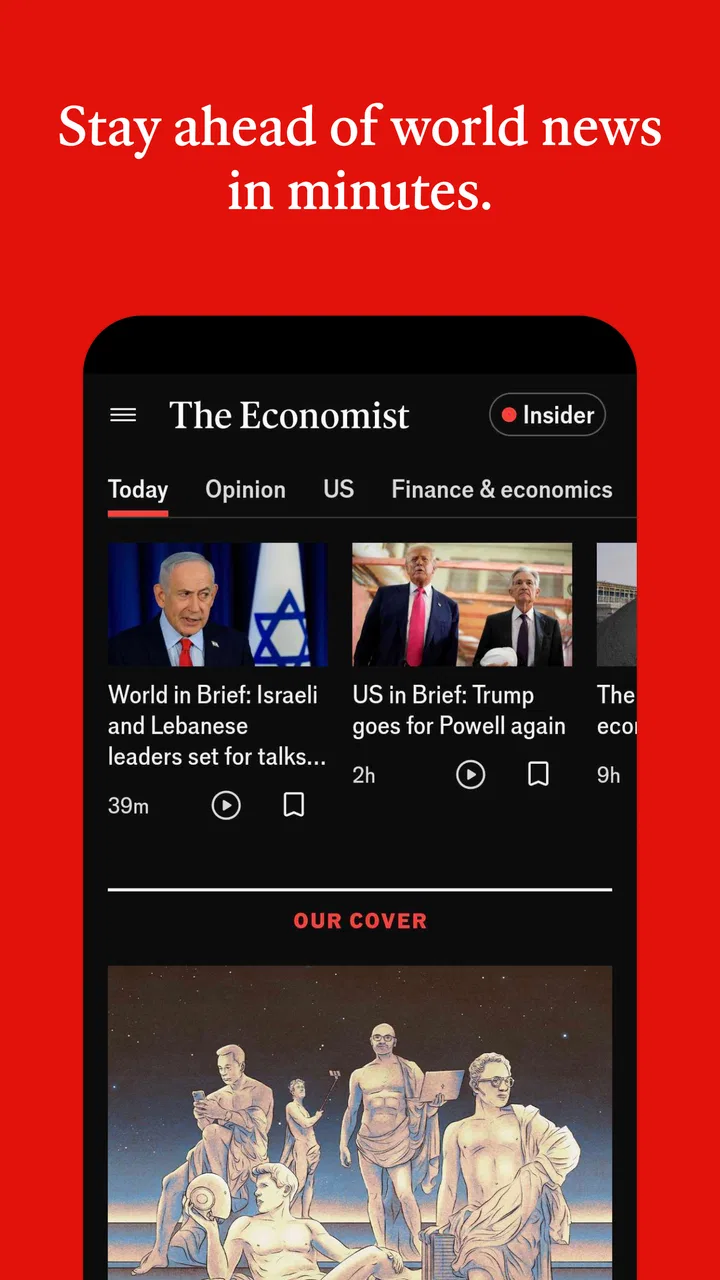
The Economist - World News
- 4.9
- Rating
- 1.00M
- Installs
- Free
- Price

 Analysis by App-foxy
I use The Economist - World News when I want more than a quick stream of headlines. It is a news and magazine app from The Economist Newspaper, built around the publication’s reporting and analysis rather than a constant flood of short updates. That difference matters: I open it when I have enough attention to understand why an event matters, not merely to see that it happened.
The app is free to install, with optional in-app purchases ranging from $6.90 to $289.00 per item. It has a Teen content rating, runs on Android 10 or later, and its current version is 4.74.0. Those details make it reasonably accessible, but the real question is whether its style suits your news routine. In my experience, it is best for readers who prefer depth, context, and a deliberate reading habit over endless scrolling.
How I use it as a daily news reader
My baseline workflow is simple. I open the app once to see what deserves attention, choose one or two subjects, and read them properly instead of trying to consume everything. That approach works particularly well here because the publication’s identity is tied to international affairs, economics, politics, business, science, and broader ideas. The app feels less like a social feed and more like a curated reading desk.
You May Also Like

 Blood Strike: 2.5 Anniversary
Blood Strike’s Loadouts Turn Every Drop Into a Tactical Gamble
A close look at Blood Strike’s custom loadouts: how fast access to signature weapons reshapes its battle royale rhythm, rewards preparation, and narrows the gap between fights.

 Pandora - Music & Podcasts
Pandora’s Music Is Easy to Start, but Harder to Recover
Pandora’s strength is its low-effort path from a seed to a station. Its weak spot is how much confidence it asks you to place in connection, setup, and quiet recovery.

 8 Ball Pool
 Is Built on Rivalries, Rematches, and Routine
A close look at the rivalries, rematches, shared routines, and unanswered safety questions that turn a quick pool match into a persistent mobile community.

 Samsung Music
’s Quiet Strength Is Playing What You Already Own
Its reach comes less from spectacle than from dependable access to a personal library. That simplicity is both the app’s strongest retention engine and its ceiling.

 AccuWeather: Weather Radar
AccuWeather Review: A Quick, Clear Forecast for Everyday Decisions
For everyday plans, the best forecast is the one you can understand quickly. AccuWeather makes rain timing, radar, and local conditions easy to act on, with a few trade-offs.

 Hill Climb Racing
Why Hill Climb Racing Still Turns Crashes Into One More Run
A tiny car, a bumpy hill and one more upgrade: Hill Climb Racing keeps resurfacing because its simple chaos makes every near-miss feel personal.
More From Our News Desk



On a normal weekday, I might check it during breakfast, scan the main selections, and save a longer article for a quieter moment. Later, I return to finish it rather than starting another dozen stories. This is a useful habit for anyone who finds ordinary news apps distracting. The value is not simply speed; it is the chance to connect an event with its background, consequences, and competing interpretations.
The app’s store summary, “Go beyond the breaking new,” points toward that editorial purpose, although I would not treat it as a replacement for urgent alerts. If something is developing minute by minute, a dedicated breaking-news service or a broadcaster’s live coverage will usually be faster. I use this app after the first alert, when I want to understand the larger picture.
That distinction is important for new users. You are not installing a general-purpose headline utility with every possible local update. You are choosing a more focused reading experience from The Economist Newspaper. The strongest use case is a person who wants international perspective and analysis in one place, especially when a short headline leaves more questions than answers.
The app has built a substantial audience, with more than one million installs, a 4.9 average from about eighty thousand ratings, and roughly 1.7 thousand written reviews. Those figures suggest strong reader satisfaction, but they should not obscure the personal nature of the choice. A high rating does not make a text-heavy publication ideal for someone who only wants sports scores, neighborhood notices, or rapid local reporting.
What the first week feels like
During the first few sessions, I recommend resisting the urge to judge the app by how many stories appear immediately. Its strength is selection and interpretation. Read a few pieces across different subjects and notice whether the writing style helps you think more clearly. If you enjoy connecting politics with markets, technology with society, or current events with long-term trends, the app becomes more useful as you build familiarity with its editorial voice.
I also pay attention to reading length. A short visit can work, but the experience becomes more rewarding when I reserve a longer block for a substantial article. That makes it less suitable for people who want every story reduced to a few lines. The trade-off is clear: the app can offer more context than a headline feed, but it asks for more concentration in return.
For a commuter, the practical routine is to browse when there is a spare minute and return to selected stories later. For a student or professional, it can serve as a way to add international context to a daily information diet. For a casual reader, the free installation makes trying it straightforward, but the purchase options mean it is worth checking what access you want before building your entire routine around it.
Settings and habits that make the experience calmer
I would not leave every notification choice untouched. News apps can easily become interruptions rather than tools, especially when several services are competing for attention. I prefer to keep only alerts that genuinely help me and rely on opening the app at a planned time for everything else. The goal is to make the app part of a routine instead of allowing it to dictate one.
It is also worth checking how the app presents reading and account-related options before you settle into a subscription decision. Because the app is free with in-app purchases, the important practical question is not only whether you like the journalism, but also which parts of the experience require a purchase. I would explore the available article access first, then decide whether the regular value matches how often I actually read.
My most useful setting is the one that protects reading time from unnecessary noise. I treat notifications as a narrow doorway into the app, not as a complete news service. If I receive too many prompts, I start ignoring all of them. A quieter setup makes the alerts I keep more meaningful and leaves room for intentional reading.
Another habit is to use the app according to energy level. I read shorter pieces when I am between tasks and reserve analysis-heavy material for an evening or weekend session. This sounds ordinary, but it prevents an easy mistake: opening a demanding article at the wrong moment, abandoning it halfway, and concluding that the app is inconvenient. Matching the article to the time available makes a noticeable difference.
I also suggest checking the operating system requirement before installing on an older device. The app requires Android 10 or later, so a phone running an earlier version is not the right environment. On a supported phone, keeping the operating system and the app current is a sensible way to avoid compatibility friction, particularly as the application continues at version 4.74.0.
Use the app as a reading queue, not a reflex
A repeatable workflow helps more than constant browsing. I look through the available coverage, choose a small number of pieces, and stop searching. This creates a personal reading queue without turning the app into another task-management system. The non-obvious benefit is that I remember more: selecting fewer articles forces me to decide what I actually want to understand.
When a subject is complicated, I read one article for its main argument and then return later to examine the supporting detail. I avoid switching between several unrelated topics in the same sitting. For me, this is especially helpful with economic or political coverage, where the meaning of a story can depend on definitions and background that are easy to lose during rapid scrolling.
The app is also useful as a counterweight to social media. Social platforms are good at showing what people are reacting to, but they often mix commentary, repetition, and incomplete context. Here, I begin with an editorially shaped reading experience. I still use other sources for local news and immediate developments, but this app gives me a more considered place to start when I want perspective.
Faster patterns for busy readers
The fastest effective pattern is not trying to read everything. I scan the available coverage, identify one important story and one subject I personally care about, then leave the rest for another session. This takes less time than opening multiple news apps and repeatedly refreshing them. It also avoids the false sense of being informed that can come from consuming many disconnected headlines.
For a morning routine, I would use the app in three passes. First, glance at the broad selection. Second, choose the article most relevant to the day ahead. Third, read only enough additional material to understand its context. If I have more time, I continue; if not, I close the app with a clear sense of what I intended to learn.
For a workday, I use a different pattern. I avoid opening a long article immediately before a meeting or deadline. Instead, I select it for later and read it during a break where interruptions are less likely. This matters because the app’s value depends on comprehension. A hurried half-reading makes detailed journalism feel slower than it really is.
For travel or waiting rooms, the app can fill a longer pause better than a stream of tiny updates. I would still prepare for situations where connectivity or battery life is limited rather than assuming every article will always be available in exactly the way I want. The safest habit is to open and organize what I plan to read before the journey, while remembering that the app’s precise offline behavior should be checked directly on the device.
One useful trade-off is choosing the app over several specialist sources when I want a broad international overview. It can reduce the number of places I check. However, that convenience does not mean it covers every need. A reader focused on local government, regional weather, live financial prices, or minute-by-minute sports results will probably need other apps alongside it.
Where it beats ordinary news feeds
Compared with a standard headline aggregator, this app feels more coherent. Aggregators are excellent when I want breadth, multiple outlets, and quick comparison. Their weakness is that the reading experience can become fragmented. The Economist - World News is more appealing when I want one publication’s editorial approach and a stronger sense of continuity between stories.
Compared with a broadcaster’s news app, it is less about immediate live coverage and more about interpretation. Compared with a social feed, it offers a more deliberate route into a subject. Compared with a specialist financial app, it is broader and more magazine-like, but it is not the tool I would choose for live market monitoring or transaction decisions.
That comparison also reveals the main limitation. A focused editorial voice can be a strength when it matches your interests, but it is not the same as seeing every viewpoint or every local source. I use it as a central reading choice, not as my only window onto the world. Cross-checking matters when a story affects a personal decision, a professional judgment, or a rapidly changing event.
Advanced limits and the purchase decision
The biggest advanced limitation is not a missing button; it is the boundary of the product’s purpose. No single news app can provide instant alerts, local reporting, specialist data, deep archives, and a calm reading experience equally well. This one prioritizes analysis and international coverage. If you want a universal dashboard, you may find it too selective.
The purchase structure deserves attention before you commit. Installation costs nothing, but in-app purchases run from $6.90 to $289.00 per item. That wide range means a casual trial and a long-term access decision are very different choices. I would first establish a reading habit, then evaluate whether I use the app often enough to justify the relevant purchase option. Buying simply because the publication is respected is not a substitute for regular use.
I would also skip it if I mainly want free, very short updates throughout the day. The app can be valuable without being the best match for that behavior. Likewise, readers who dislike longer articles, want a strongly customized multi-source feed, or need highly local coverage should look at alternatives designed around those priorities.
Its Teen content rating is another practical point for households. The rating makes it more suitable for older readers than a child-focused news product, but parents should still consider the subjects and tone of current-affairs journalism. The app deals with real-world events and serious issues, so suitability depends on the individual reader as well as the label.
For experienced users, mastery comes from accepting those boundaries. I do not ask the app to replace every other source. I use it for the part of my information routine where context matters, keep a faster service for urgent developments, and use specialist tools when I need local or technical detail. That division of labor makes the app feel more useful and prevents unrealistic expectations.
Who should make it a regular habit
I would recommend it to a reader who wants to understand international events rather than simply collect headlines. It is particularly well suited to people who enjoy economics, politics, business, science, and ideas, and who can give an article enough uninterrupted attention to be worthwhile. It also suits anyone trying to replace compulsive news refreshing with a smaller, more intentional reading routine.
I would be more cautious for a reader who needs immediate alerts, local reporting, or a large range of independent sources in one feed. The app can complement those needs, but it should not be expected to handle them all. The same goes for someone who is unwilling to consider in-app purchases after the free installation; the access model should be part of the decision from the beginning.
My practical recommendation is to test it during a real week rather than judging it after one quick scan. Use it at breakfast, return to one substantial article later, and notice whether the reading improves your understanding or merely adds another notification. That experiment answers the important question better than the rating alone: does this publication fit the way you want to stay informed?
After using it as part of a broader news routine, I see The Economist - World News as a strong specialist choice rather than a universal news replacement. The free entry point makes it easy to explore, the high average rating reflects broad appeal, and the app’s focused editorial style gives it a clear identity. Its limitations are equally clear: it may feel too deliberate for breaking news and too selective for readers who want every local or specialist update.
My final verdict is positive, with one condition: choose it for understanding, not for constant notification. If you build a repeatable habit around selecting a few meaningful stories, checking the settings that control interruptions, and keeping faster or more local tools for their proper jobs, the app becomes a thoughtful part of a daily news routine. If that slower, analytical approach is not what you want, a conventional aggregator or live-news service will probably serve you better.
FAQs for The Economist - World News
01What features does The Economist - World News app offer?
The Economist - World News app provides users with access to in-depth articles, audio versions of each issue, daily briefings, and curated content on global affairs. Users can personalize their reading experience with options to save articles for offline reading and receive notifications about breaking news and special reports.
02Is a subscription required to access all content?
Yes, while the app offers some free articles, a subscription is required to unlock full access to all of The Economist’s content. Subscribers can enjoy the latest issues, complete archives, and exclusive features such as the audio edition and special reports. Subscription options are available within the app.
03Can I read articles offline on The Economist app?
Absolutely. The Economist app allows you to download articles and full issues to read offline, making it convenient for users who are frequently on the go or have limited internet access. Simply save the content you wish to read later, and it will be available without an internet connection.
04How frequently is the content updated in the app?
The app is updated daily with the latest news and analysis. In addition to the weekly digital edition of The Economist magazine, users can access daily briefings, which provide concise updates on global events, ensuring you stay informed of the most important stories as they unfold.
05Does The Economist app support audio features?
Yes, The Economist app includes an audio edition feature, allowing users to listen to articles while multitasking or commuting. The audio version is professionally narrated and covers the entire content of the latest issue, making it a versatile option for those who prefer audio consumption.
Pros
- Comprehensive global news coverage.
- In-depth analysis and insights.
- User-friendly interface.
- Customizable notifications.
- Offline reading available.
Cons
- Requires a subscription for full access.
- Occasional app crashes reported.
- Limited multimedia content.
- No dark mode feature.
- Content updates could be faster.

The Economist - World News
Gallery